For more than a decade the standard fix for weak passwords in UK banking has been a code sent by text message. That fix is wearing out. In 2026 the NCSC said passkeys should be the default way consumers sign in, and government rolled them out to more than 23 million people. For UK financial services, the question is no longer whether, but how fast.
- Code-based MFA is phishable. Passkeys are not. The NCSC found all traditional MFA methods inherently phishable.
- Unauthorised losses usually land on the firm. Account takeover is a balance-sheet issue, not only a customer one.
- The benchmark for “reasonable” has moved. Government now offers passkeys at national scale.
- Recovery is the new attack surface. Fallbacks and re-enrolment need the same assurance as the passkey.
- Start with your own staff. You control the devices, so it is the fastest win.
stolen through UK payment fraud in 2025
UK Financerise in unauthorised fraud cases, to 3.81m
UK Financerise in SIM swaps, which defeat SMS codes
CifasGOV.UK One Login users now offered passkeys
GOV.UKWhy the front door of UK financial services needs to change
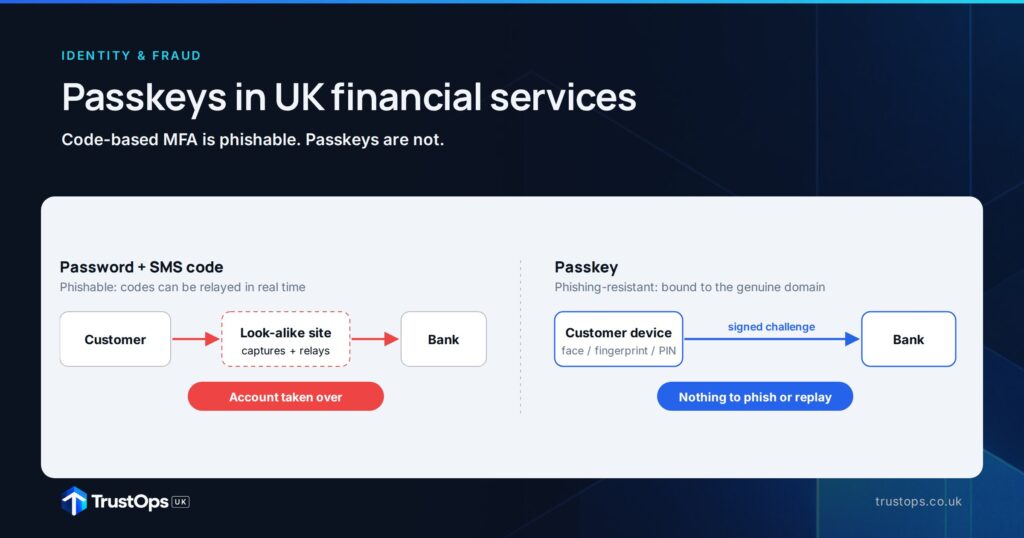
A fake login page can relay an SMS code in real time. It cannot relay a passkey.
The passkey only answers the genuine domain it was created for.
TrustOps UK illustration, based on NCSC guidance.
Where the £1.28bn went in 2025
Unauthorised fraud, where the criminal acts without the customer, is the larger share.
Unauthorised losses by type. Source: UK Finance Annual Fraud Report 2026.
Attempts are rising faster than losses
Change 2024 to 2025. Controls are holding losses down at a growing cost.
Sources: UK Finance Annual Fraud Report 2026; Cifas Fraudscape 2026.
2026: the year the UK moved
Four moments that changed what “reasonable” looks like.
Sources: Cifas; NCSC; UK Finance; GOV.UK.
Where authentication should be heading
Authentication mapped to the TrustOps Maturity Model.
Password + SMS for most users
Phishing-resistant MFA for staff and approvers
Customer passkeys, outcomes measured
Passkeys by default, weak fallbacks retired
TrustOps UK analysis.
Graphics advance automatically. Hover or select a tab to pause.

What a passkey is
A passkey is a login credential built on the FIDO2 standards. Instead of a shared secret that the customer types in, the customer’s device holds a private key and proves it has it by signing a challenge from your service. The customer unlocks it with a fingerprint, face scan or device PIN, the same way they unlock their phone.
- Nothing reusable crosses the network. There is no password database to breach and no code to replay.
- Each passkey is bound to the genuine domain or app it was created for. A look-alike site cannot request it, however convincing it looks.
Where the login requires the biometric or PIN step, the NCSC confirms that a FIDO2 login counts as multi-factor authentication.
What changed in 2026
- The NCSC’s position hardened. Its April 2026 technical assessment found that “all traditional MFA methods… are inherently phishable” and that passkeys offer stronger protection than the best-implemented traditional MFA.
- Government went first at scale. After a trial with over 300,000 people, GOV.UK One Login offered passkeys to more than 23 million users. Passkey sign-ins are up to eight times faster than a password plus two-step verification.
- Customers are already enrolled elsewhere. More than half of active UK Google users have registered a passkey.
The result is an awkward comparison. A UK customer can now sign in to their tax account with a phishing-resistant credential, then sign in to their bank with a password and a text message. Customers will notice that gap. So will the press after the next account takeover story, and so will supervisors.
Adopting passkeys wherever you can is a strong step towards a safer, simpler login experience.
Jonathon Ellison, Director for National Resilience, NCSC, April 2026Why financial services should care more than most
The fraud numbers point at authentication
UK Finance records £1.28 billion stolen through payment fraud in 2025, with unauthorised fraud cases up 11% to 3.81 million. It specifically notes criminals compromising one-time passcodes to register digital wallets and make fraudulent transactions. Remote banking fraud losses fell 27% to £104.4 million, but case volumes rose 11%: controls are holding while attempts keep climbing.
Account takeover and SIM swaps
Cifas recorded more than 78,000 account takeover cases in 2025, up 6%, with SIM swaps up 38%. A SIM swap turns an SMS code into a gift to the attacker. A passkey on the customer’s device does not move with the phone number.
Unauthorised losses usually land on the firm
Under the Payment Services Regulations 2017, the provider must generally refund an unauthorised payment. The customer bears the loss only in limited cases such as fraud or gross negligence. Authentication strength is one of the few controls that acts directly on that line.
Consumer Duty raises the bar for “reasonable”
The Consumer Duty requires firms to avoid causing foreseeable harm. Nothing in it mandates passkeys. But once the national technical authority has published that code-based MFA is phishable and a stronger option is widely available, harm from phished codes is harder to call unforeseeable. In our view, that shifts what a reasonable control set looks like.
The same logic applies to your own staff
Phishing remains the most common and most disruptive breach type reported by UK businesses (DSIT). Payment approvers, administrators, the service desk and anyone with remote access are the accounts attackers want.
Regulation: permitted, not yet mandated
Strong customer authentication needs two of three elements
A passkey unlocked by biometric or device PIN on a registered device is designed to meet that test.
Document how your implementation maps to the SCA elements, particularly for synced passkeys, and have compliance sign off the analysis. The FCA also expects SCA to work for all groups of consumers, including methods that do not rely on a mobile phone. Make passkeys the primary route, not the only one: hardware security keys and card readers remain valid options.
Where passkey rollouts go wrong

01Leaving the back door open
If an enrolled customer can still sign in with a password and SMS code, an attacker will choose that route.
02Weak account recovery
If a new device can be enrolled after a call-centre agent checks date of birth and postcode, the attack moves to the call centre.
03Treating it as an IT project
Passkeys change customer journeys, fraud rules, contact-centre scripts and vulnerable-customer handling.
04Ignoring where synced passkeys live
Synced passkeys depend on the security of the customer’s Apple, Google or Microsoft account.
A practical rollout sequence
Start with staff, prove it with customers, then make it the default
Indicative timescales. They depend on your identity platform, app release cycle and change governance.
| Phase | Evidence for the board |
|---|---|
| 1. Workforce | % of privileged and payment-approval accounts on phishing-resistant MFA |
| 2. Customer opt-in | Enrolment rate, sign-in success, drop-off, contact-centre volumes |
| 3. Default | Account takeover and remote banking fraud by authentication method |
| Ongoing | Complaints and accessibility outcomes by method |

Four questions for your next board or ExCo
Where do you stand?
Phishing-resistant MFA for privileged staff and payment approvers is a Level 3 (Managed) capability. Customer passkeys with measured outcomes is Level 4 (Measured). Passkeys by default, with hardened recovery and weaker fallbacks retired, is Level 5 (Optimised). A firm with strong fraud analytics but code-based MFA at the front door is often further back on authentication than its overall posture suggests.
A TrustOps Framework Assessment maps your controls against the model and gives your board a costed, sequenced plan. Or start with the free 15-minute assessment.
Sources (11 UK primary sources)
- NCSC, Leave passwords in the past: passkeys are the future (23 Apr 2026)
- NCSC, Passkeys are more secure than traditional ways to log in (23 Apr 2026)
- NCSC, Passkeys: what you need to know
- GOV.UK, Millions of people to benefit from simpler, more secure way to sign in to government services (14 Sep 2026)
- UK Finance, Annual Fraud Report 2026
- UK Finance, Fraud report 2026 press release
- Cifas, Fraudscape 2026 (12 Mar 2026)
- DSIT, Cyber Security Breaches Survey 2025/2026 (30 Apr 2026)
- FCA, Strong customer authentication
- FCA, Consumer Duty
- Payment Services Regulations 2017, regulations 76 and 77
General information, current as of September 2026. Not legal or regulated compliance advice. Verify against current primary sources.