For years, round-the-clock security monitoring was something only large enterprises could contemplate. The tools were costly, and you needed a team of analysts watching them at three in the morning. Most small firms concluded, reasonably, that it was out of reach and left their logs unread. That calculation has changed. A combination of managed services and automation has brought continuous monitoring within reach of a 30-person business. This article explains what these services are in plain English, why they used to be expensive, what changed, and what you should realistically expect.
SIEM and SOC, without the jargon
A SIEM, which stands for Security Information and Event Management, is the plumbing. It is a system that collects logs from your laptops, servers, email and cloud services into one place, and raises an alert when something looks suspicious, such as an impossible login or a burst of failed password attempts. It is the smoke detector wired across the whole building.
A SOC, a Security Operations Centre, is the people. It is the team that watches those alerts, decides which ones matter, and acts on the real ones. A smoke detector is only useful if someone answers it, and the SOC is that someone. Together, a SIEM and a SOC give you the two halves of monitoring: the ability to see, and the ability to respond.
Why this used to be enterprise-only
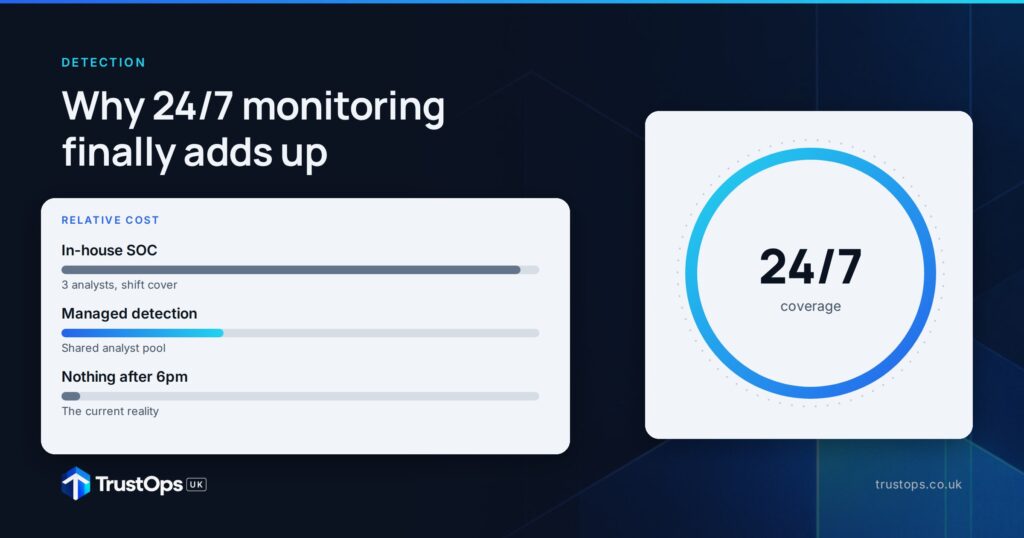
The economics were brutal for a small firm. Genuine 24/7 coverage means analysts working around the clock in shifts, and industry guidance has long put the minimum staffing for an in-house round-the-clock capability at several analysts, on top of the platform, threat intelligence feeds and response tooling. Building that in-house runs into hundreds of thousands of pounds a year (Preferred Data). No 30-person business could justify it, so the practical choice was to hope nothing happened overnight.
What changed the economics
Two things brought the price down. First, managed services. A managed detection and response provider runs one SIEM platform and one analyst team across many client businesses, so the fixed cost of the platform and the overnight staffing is shared rather than carried alone. You rent a slice of a capability instead of building the whole thing.
Second, automation. Modern tooling handles the high-volume, repetitive first pass: gathering context on an alert, filtering out obvious noise, and grouping related events, so that a human analyst spends their time on the alerts that actually need judgement. This is the sensible use of automation in security. It does not replace the analyst. It removes the drudgery so a smaller team can cover more ground, which is what makes the service affordable. Treat any claim that automation removes the need for people with healthy scepticism.
What good looks like for an SME
You do not need an enterprise SOC. For a firm of 25 to 250 people, a sensible service covers the systems that matter most, usually cloud email, identity and endpoints, and delivers a small number of things well:
- Log collection from your key systems into one place, with a sensible retention period.
- Alerting on the events that matter, tuned to your environment so you are not drowned in noise.
- A human who triages real alerts and tells you what to do, within an agreed response time.
- A monthly report a non-technical owner can read, and a clear escalation path when something serious happens.
The gap monitoring closes
Why does the speed of noticing matter so much? Because attackers move quickly once they are in, and the longer an intrusion goes unseen, the more it costs to clean up. The value of monitoring is not that it catches everything, but that it collapses the time between a compromise and a response from weeks to hours. For a small business without an in-house team, that is often the difference between an incident you contain quietly and one that becomes a reportable breach with customers to notify and a restore to run under pressure.
Realistic expectations: not magic
Monitoring is powerful, but it is not a force field. It shortens the time between something going wrong and someone noticing, which is often the difference between a contained incident and a crisis. It does not stop every attack, and it does not replace the basics: multi-factor authentication, patching and tested backups still do the heavy lifting. An honest SME-scale monitoring service is clear about what it does and does not cover, and prices accordingly. At TrustOps, monitoring and advisory are sized to the business, with a fixed monthly fee agreed up front, rather than sold as an enterprise platform you will never fully use.
How to choose a service without being oversold
The market is noisy, and a lot of it is dressed up in language designed to impress rather than inform. A few practical questions cut through it:
- Who actually watches the alerts, and when? If the answer is that it is fully automated with no human, ask what happens at 2am when the automation is unsure.
- What is your response time, and what does response mean? Sending you an email is not the same as acting on your behalf.
- Which of my systems will you cover, and which will you not? Honest gaps are better than vague reassurance.
- Can I see a sample monthly report? If a non-technical owner cannot understand it, it will not get read.
Be wary of any pitch that leans on the word intelligent or promises to remove the need for people entirely. The sensible use of automation is to make a human team more effective, not to pretend the humans are unnecessary.
How this maps to the TrustOps Maturity Model
Monitoring lives in the Detect and Respond functions of the framework we build on. Turning logs from something you keep and never read into something a person watches and acts on is the core move from Level 4 (Measured) to Level 5 (Optimised): continuous assurance rather than an annual snapshot. Your security posture, live, not once a year.
If you are not sure where you stand today, the honest first move is to find out. Our free 15-minute assessment scores you out of 100 against the same six functions, shows your top five gaps, and gives you a maturity level you can act on, whether or not we ever speak again. Start with the free assessment at trustops.co.uk.
Sources
Preferred Data – SIEM and SOC for Small Business (in-house 24/7 SOC staffing and cost; shared managed-service model): https://www.preferreddata.com/blog/siem-soc-small-business-ai-security-north-carolina-2026
NCSC – Logging and protective monitoring guidance: https://www.ncsc.gov.uk/collection/mobile-device-guidance/logging-and-protective-monitoring
DSIT – Cyber Security Breaches Survey 2025/2026 (breach prevalence context for SMEs): https://www.gov.uk/government/statistics/cyber-security-breaches-survey-20252026/cyber-security-breaches-survey-20252026