For a decade the default answer to a new threat was a new tool. Many large firms now run dozens of overlapping products, with scattered telemetry and plenty of shelfware. The NCSC expects AI to make attacks more frequent and more intense through 2027, while firms adopt AI themselves at speed. The question for a CISO has moved from “how do we stop the next attack?” to “can we run safely, recover quickly and prove our biggest risks are under control?” That changes where the money should go.
- Govern identities, not accounts. Staff, workloads, service accounts and AI agents all need owned, limited identities.
- Fund recovery as seriously as prevention. Boards want to know how long a critical service would be down.
- Make AI security a formal domain. An agent that can call tools and APIs is a privileged user.
- Buy less, use more. Rationalise the estate before adding to it.
- Measure in business terms. Tie each investment to an important service and a NIST CSF 2.0 outcome.
nationally significant incidents handled by the NCSC in a year, up from 89
NCSCof large UK businesses had a breach or attack in the last 12 months
DSITof businesses review risk from their immediate suppliers
DSITNCSC deadline to finish post-quantum discovery and plan migration
NCSCWhy 2027 budgets need a different shape
Attackers move in days. Many fix cycles still take weeks.
The NCSC expects AI to shrink the exploitation window further.
Illustrative cycle. Exploitation window: NCSC, Impact of AI on cyber threat from now to 2027.
Nationally significant incidents more than doubled
Incidents handled by the NCSC, year to September 2025.
Source: NCSC Annual Review 2025.
Governance and supply chain are where most firms are thin
Share of all UK businesses, 2025/26.
Source: DSIT Cyber Security Breaches Survey 2025/2026.
The dates already in the 2027 plan
Regulation and migration deadlines that need budget now.
Sources: UK Parliament; Bank of England / PRA; NCSC.
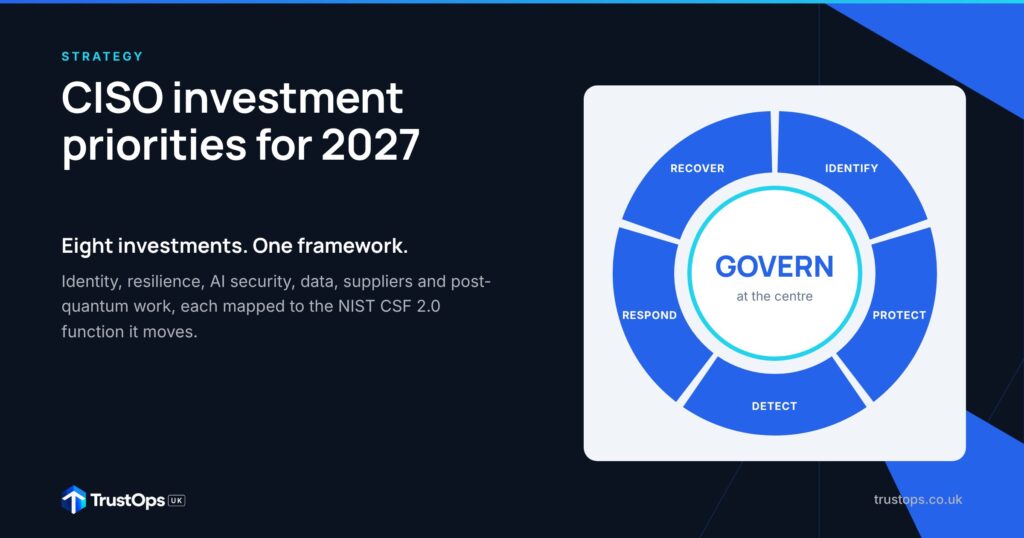
Eight investments on one framework
Each priority mapped to the NIST CSF 2.0 functions it moves.
TrustOps UK analysis against NIST CSF 2.0.
Graphics advance automatically. Hover or select a tab to pause.

1. Identity becomes the control plane
Identity is no longer just the perimeter. It decides whether every action in the firm is allowed. Non-human identities are multiplying: workloads, APIs, service accounts, containers and AI agents. An agent that can read the CRM, query a database and start a workflow is a privileged user in all but name.
The NCSC’s August 2026 guidance on agentic AI says “all agents should be assigned their own unique identity” and that, where possible, firms “should restrict the credentials available to the agent”. For people, it says that where services support passkeys, “they should generally be used”.
- Invest in: phishing-resistant sign-in (passkeys, FIDO2), privileged access with just-in-time rights, automated joiner-mover-leaver, workload and agent identity, removing hard-coded secrets, identity threat detection.
- NIST CSF 2.0: PR.AA, identity management, authentication and access control.
2. Fund recovery as seriously as prevention
Most programmes are still measured on prevention: patches applied, emails blocked, alerts raised. Those numbers do not answer the board’s real question: if an attack succeeds tomorrow, can we keep trading?
Ransomware remains one of the most acute and pervasive cyber threats to UK organisations.
NCSC, Annual Review 2025A disaster recovery test that restores a server is not the same as rebuilding a customer service after Active Directory, endpoints and admin tooling have all been compromised at once. The biggest cost of a major incident is usually the disruption, not the initial break-in.
- Invest in: immutable and isolated backups, clean-room recovery, automated rebuild of core infrastructure, critical service mapping, destructive-attack exercises with the business, crisis management.
- NIST CSF 2.0: RC.RP, incident recovery plan execution; RS.MA, incident management.

3. Make AI security a formal domain
The debate about whether staff may use generative AI is over. The work now is controlling copilots, in-house models, AI features inside SaaS, retrieval systems, agents and AI-written code. Software that can reason and call tools changes the attack surface, and traditional application security does not cover all of it.
A workable AI security architecture answers eight questions:
- Who can access or change models?
- What data can they ingest, keep or expose?
- What can agents do, and which APIs and credentials can they call?
- How is prompt injection handled?
- Which models, datasets and plugins are trusted?
- Is abnormal behaviour detected?
- Who owns each AI system?
- Which business decisions does it influence?
The DSIT AI Cyber Security Code of Practice sets a baseline, including that the permissions an AI system holds on other systems are “only provided as required for functionality and are risk assessed”. In our view, CISOs will be judged on how safely they let the firm adopt AI, not on how well they slow it down.
- NIST CSF 2.0: GV.OC and GV.RM for context and risk strategy; PR.AA and PR.DS for access and data.
4. Security engineering at machine speed
The NCSC expects the most significant AI development in cyber to be AI-assisted vulnerability research and exploit development, and says the time between disclosure and exploitation has already shrunk to days. A firm that takes two weeks to assess a vulnerability, a week to find the owner and two more to schedule a fix is losing that race.
The aim is to shrink the cycle of discover, understand, prioritise, fix and validate from weeks to hours wherever possible, without simply producing more alerts.
- Invest in: attack surface and exposure management, risk-based prioritisation, automated control validation, software composition and infrastructure-as-code scanning, automated remediation, AI-assisted SOC triage.
- NIST CSF 2.0: ID.RA, risk assessment; DE.CM, continuous monitoring; ID.IM, improvement.
5. Put data security back at the centre
AI systems run on data. Connect an assistant to SharePoint, email, CRM and source code, and files that were technically open but hard to find become one question away. Old permission problems turn into real exposure. The test: do we know where our sensitive data is, who can reach it, and which AI systems can read it?
- Invest in: discovery and classification, entitlement clean-up, data security posture management, data loss prevention, encryption and key management.
- NIST CSF 2.0: ID.AM, asset management; PR.DS, data security.
6. Rationalise before you add
More tools do not mean more security. Overlapping products bring duplicated telemetry, licence cost, integration work and controls that are bought but half deployed. Before any new purchase, ask whether you already own the capability, whether an existing platform could provide it, what it will replace and what measurable risk reduction it will deliver.
The aim is fewer strategic platforms, integrated more deeply and used more fully. That is not a case for a single vendor.
7. Supplier resilience beyond questionnaires
A large share of cyber risk sits with cloud providers, SaaS, managed service providers, software and payment suppliers and, increasingly, AI providers. Annual questionnaires give a snapshot. Only 15% of UK businesses review risk from immediate suppliers, and 6% from the wider supply chain.
Regulation is pushing the same way. The Cyber Security and Resilience Bill brings medium and large managed service providers into scope, lets regulators designate critical suppliers and introduces an initial incident notice within 24 hours and a fuller report at 72 hours. Its Lords Report stage is scheduled for 26 October 2026. For banks and building societies, PRA reporting under PS7/26 applies from 18 March 2027.
- Invest in: continuous supplier monitoring, fourth-party and concentration mapping, SBOMs, contract security clauses, joint incident exercises, exit plans.
- NIST CSF 2.0: GV.SC, cyber supply chain risk management.
8. Start post-quantum work now
The task is not urgent replacement. It is the discovery needed to replace safely. The NCSC asks firms to finish discovery and an initial plan by 2028, complete the highest-priority migration by 2031 and finish by 2035. NIST published its first three post-quantum standards, FIPS 203, 204 and 205, in August 2024.
Most firms cannot yet answer a basic question: where do we use cryptography? Start there.
- Invest in: cryptographic and certificate inventories, crypto-agility in new systems, supplier readiness checks, identifying long-lived sensitive data.
- NIST CSF 2.0: ID.AM and PR.DS.
Sequencing the 2027 budget
Indicative. Visibility first, then foundations, then the work that depends on them.
People: change how the team spends its time
AI can already help with log analysis, detection writing, alert triage, code review and compliance evidence. The opportunity is to take low-value work off skilled people, not to replace them. An architect should not spend hours collecting evidence by hand. The most valuable people will be those who can work across security, automation, AI, cloud and business risk.
Measurement underpins everything
Boards get plenty of numbers: vulnerabilities, incidents, phishing test results, patch rates. Few of them say how much risk the firm carries. Compare “98.3% of endpoints have EDR” with “every system supporting our Tier 1 payment service has tested detection, containment and recovery”. The second ties spend to a business outcome.
The UK Cyber Governance Code of Practice expects boards to govern cyber risk like any other material risk. A NIST CSF 2.0 current and target profile is a practical way to show the board what each pound moves.
| Area | Question for 2027 | CSF 2.0 |
|---|---|---|
| Identity | Can we control every human, machine and AI identity? | Protect |
| Resilience | Can our most important services recover after a successful attack? | Recover |
| AI | Can we adopt AI quickly without losing control of data or systems? | Govern |
| Engineering | Can security work close to machine speed? | Identify, Detect |
| Data | Do we know where important data is and who, or what, can reach it? | Protect |
| Ecosystem | Do we understand the suppliers behind our critical services? | Govern |
| Cryptography | Are we ready for post-quantum migration? | Identify |
| Measurement | Can we show spend reduces business risk? | Govern |
Where 2027 budgets go wrong
01A new tool for every headline
Each purchase adds licence cost, integration work and another console nobody fully uses.
02Testing restore, not recovery
Restoring a server proves little if identity infrastructure is gone too.
03Treating AI agents as software, not users
Agents inherit broad service credentials and nobody reviews what they can reach.
04Starting post-quantum with replacement
Without an inventory, a migration programme has nothing reliable to plan against.
Four questions for your next board or ExCo
Where do you stand?
Phishing-resistant identity for privileged users and isolated, tested backups is a Level 3 (Managed) capability. Investment mapped to a CSF 2.0 target profile and measured against important services is Level 4 (Measured). Recovery, supplier and AI controls tested together and reported to the board in business terms is Level 5 (Optimised).
A TrustOps Framework Assessment scores you against NIST CSF 2.0 and gives your board a costed, sequenced plan. Or start with the free 15-minute assessment.
Sources (13 primary sources)
- NCSC, Impact of AI on cyber threat from now to 2027 (7 May 2025)
- NCSC, UK experiencing four ‘nationally significant’ cyber attacks every week (14 Oct 2025)
- NCSC, Annual Review 2025
- NCSC, Passkeys are more secure than traditional ways to log in (23 Apr 2026)
- NCSC, Managing the cyber risk of agentic AI (20 Aug 2026)
- NCSC, Timelines for migration to post-quantum cryptography (20 Mar 2025)
- NIST, First three finalised post-quantum encryption standards (13 Aug 2024)
- NIST, Cybersecurity Framework 2.0 (26 Feb 2024)
- DSIT, Cyber Security Breaches Survey 2025/2026 (30 Apr 2026)
- DSIT, Code of Practice for the Cyber Security of AI (31 Jan 2025)
- DSIT, Cyber Governance Code of Practice (8 Apr 2025)
- UK Parliament, Cyber Security and Resilience Bill: stages; GOV.UK, incident reporting factsheet
- Bank of England / PRA, PS7/26 Operational incident and third-party reporting (18 Mar 2026)
General information, current as of October 2026. Not legal or regulated compliance advice. Verify against current primary sources.